
Friday, March 31, 2006
announcement lang
this news care of major tato marcial: ariel 'isluggo' ante (batch 85) is now a lawyer, having passed the most recent bar exams. congrats, sano!

Monday, February 20, 2006
Monday, February 13, 2006
stampeding poverty, pseudo generosity
(Medyo history na ini na post but i want to share this still. This article was originally published at Landmarks (DAR Publication) last year. Surprisingly, the points I raised were similar to PDI's Editorial last February 7, 2006 on the ULTRA stampede. May premonition ba ako or talagang jinx lang? Nanay ko, mapasantigwar na ako!!! Anyway, should i say enjoy reading or try to enjoy while reading....whatever...)
REALITY GAME, PINOY VERSION
By Toteperez, PIO – DAR Sorsogon
A priest – formator in a high school seminary were I studied once gave a very amusing remark during an opening ceremony in one of our intramurals. He claimed that the honorable founders of our venerable institution made an inadvertent omission in our seminary motto, which says ORA, STUDE ET LABORA (Latin for prayer, study and work). Obviously, PLAY was missing. But he opined that the founders were wise enough not to include that word since we play while we pray, study and work anyway. He concluded that intramurals is one great occasion when we can play, officially and formally.
The short speech elicited hilarious laughter. I dismissed it as one of the wittiest speeches I ever heard in my life. But years later while taking up college in a religious congregation, I finally understood the truth and the wisdom behind that memorable remark.
We were then regularly assigned to do simple chores such as washing dishes and cleaning the grounds. Consistently, it was observed that when Filipino confreres were doing the dishes, the wash area is one happy place filled with laughter, jokes, singing and other acts that go along while doing the job.
But the opposite happens when Koreans are doing the dishes; you can only hear the sound of tinkling utensils and flowing water from faucets as if washing the dishes is one form of meditation. I dared to ask one Korean brother on their “Sound of Silence.” He simply said : “You know, we Koreans work when we work and play when we play. You Filipinos work and play at the same time!”
Most, if not all Filipinos cope up with life’s challenges by making it easier with wit, humor and, yes, play. Laro – laro lang ang buhay, ‘ika nga (life’s a game, they say). If you take your life seriously in the present day Philippines, chances are, you may lose your sanity - nakakapraning, as the pun goes.
Living in a Third World Country with unstable economy and politics, life will surely be a roller – coaster hell-of-a-ride complete with unpredictable ups, downs, turns and swerves. Because of life’s unpredictability, Filipinos tend to gamble with it and even make pusta or bet on anything that is worth betting on.
Pustahan is one overused word that finds its way in every Filipino’s conversation. Filipinos make pusta on anything “under the sun” so to speak like; the weather - taya ng panahon (weather forecast), courtship, job, business transactions, politics, sports, and what have you. Filipinos are more than creative to innovate on anything that is possible for betting.
Even some unexpected situations were exploited to satisfy the urge to bet. Imagine the popular “ending” game, i.e. betting on the last digits on the final results of any Philippine Basketball Association (PBA) game. Even a child’s play was not spared ; Laban ng Gagamba (spider’s fight) elicits betting from adult mirons (onlookers). Definitely, no other country has this kind of craving for betting but “Onli In Da Pilipins!”
Pustahan only confirms one thing : The innate desire to gain reward, profit or benefit, usually monetary. It also presupposes one reality : the existence of an imbalanced condition wherein the bettor has to risk his meager resources with slim chance to gain greater rewards. But why do Filipinos indulge in pustahan under this circumstance ?
This is where the Bahala Na (Come What May) Attitude comes to the fore. Scholars claim that bahala na attitude may actually mean “Bathala Na ” (God will provide). This displaced folk religiosity has both positive and negative implications. If taken on a positive light, this is a manifestation of complete trust with God’s generous grace, or just plain guts, will or drive to achieve despite the odds. However, on the negative, this is a display of complete disregard of whatever consequences may come along or just plain crazy risk taking.
Be it uncalculated risk taking or just pure will to win in a very unwarranted situation, it does not matter anymore for what matters to majority of the Filipinos who live below poverty line is to survive in a life that seems to be a game of chance.
No wonder game shows on television are gaining wide and wild following due to instantaneous rewards it project complete with noisy fanfare. Long queues stretching lengthily before the gates of big television networks define the cross section of Filipino society, each of them hoping and praying for lady luck to smile favorably at their side.
Likewise, advertisers and network owners both wear wide grins on their faces as if hitting a pot of gold as revenues and sales pour in like rain on this genre of show. Eventually, they are the real winners of the entire performance of the so-called reality TV shows complete with drama and suspense. Brief on –air interviews on game show contestants and winners would reveal an otherwise unrehearsed real-life stories that could pass as soap drama materials. Exploiting raw emotions on camera makes the supposedly entertainment show a tearjerker as if tears and wailing would elicit enjoyment from the viewers.
But the real purpose for these emotionally – charged acts is to project a benevolent image for the station and sometimes, the hosts themselves. Its was even reported that people trooped to the house of a famous (or infamous) game show host, asking for donations and dole – outs thinking that he was responsible for the rewards at stake during game shows, despite his tarnished image. Soon, we can even expect some game show hosts running and winning on elected positions.
The television game shows cater to the basic Filipino penchant to believe on fairytale – like stories of rags-to-riches by taking the shortcut of hitting the jackpot instead of taking the circuitous process and honest-to-goodness hard work to succeed in life. Even the fad of reality talent search shows on TV is an affirmation of this desire to pusta oneself in one reality game show.
The TV game shows or even reality talent search shows are venues where Filipinos create heroes or ‘mythos’ out of themselves, projecting their dreams on the prizes at stake. Most if not all of those who patiently stayed on the queue just to join on these shows are not there just for fun and entertainment. They are there because they are hanging on to dear life - kapit sa patalim (clutching on the blade), they have no more option left but gamble their future on a TV game or reality talent search shows to improve their lot, placing all their trust to the production team and network owners and sponsoring advertisers.
Established TV game shows and reality talent search shows may reach its peak and wane in popularity in the passage of time, but for sure, these will just metamorphose, reformat and resurrect like phoenixes from the ashes. TV network marketing and sales executives even become more creative in injecting some ‘games’ even on Telenovelas by flashing some trivia questions regarding the episodes and other similar gimmicks, of course with corresponding prizes at stake.
As long as majority of the Filipinos remain poor and were denied access to basic services that they ought to enjoy and benefit from, they will continually put their trust and belief in the palliative solutions that TV networks offer through these shows on game of luck. And as long as the Filipinos treat elections like a game of chance, the vicious cycle of poverty will steadily grind.
To prove this point : I once asked a voter why is she voting for her chosen candidate. Her reply ? She is voting for her candidate because he has the highest chance of winning. Another incident : I asked another voter why is he not casting his vote yet with almost only a few minutes before the voting precincts close. His answer which I really expected to hear ; He is waiting for the highest ‘bidder’ to buy his vote.
Maybe my former priest – formator was right, so does the Korean confrere. There is a need to put delineation between play and other acts, there is a need to separate reality from make – believe.
This way, we can be serious with life as needed and play when we really mean it.
For sure we will have higher chances of winning in the game called LIFE.
REALITY GAME, PINOY VERSION
By Toteperez, PIO – DAR Sorsogon
A priest – formator in a high school seminary were I studied once gave a very amusing remark during an opening ceremony in one of our intramurals. He claimed that the honorable founders of our venerable institution made an inadvertent omission in our seminary motto, which says ORA, STUDE ET LABORA (Latin for prayer, study and work). Obviously, PLAY was missing. But he opined that the founders were wise enough not to include that word since we play while we pray, study and work anyway. He concluded that intramurals is one great occasion when we can play, officially and formally.
The short speech elicited hilarious laughter. I dismissed it as one of the wittiest speeches I ever heard in my life. But years later while taking up college in a religious congregation, I finally understood the truth and the wisdom behind that memorable remark.
We were then regularly assigned to do simple chores such as washing dishes and cleaning the grounds. Consistently, it was observed that when Filipino confreres were doing the dishes, the wash area is one happy place filled with laughter, jokes, singing and other acts that go along while doing the job.
But the opposite happens when Koreans are doing the dishes; you can only hear the sound of tinkling utensils and flowing water from faucets as if washing the dishes is one form of meditation. I dared to ask one Korean brother on their “Sound of Silence.” He simply said : “You know, we Koreans work when we work and play when we play. You Filipinos work and play at the same time!”
Most, if not all Filipinos cope up with life’s challenges by making it easier with wit, humor and, yes, play. Laro – laro lang ang buhay, ‘ika nga (life’s a game, they say). If you take your life seriously in the present day Philippines, chances are, you may lose your sanity - nakakapraning, as the pun goes.
Living in a Third World Country with unstable economy and politics, life will surely be a roller – coaster hell-of-a-ride complete with unpredictable ups, downs, turns and swerves. Because of life’s unpredictability, Filipinos tend to gamble with it and even make pusta or bet on anything that is worth betting on.
Pustahan is one overused word that finds its way in every Filipino’s conversation. Filipinos make pusta on anything “under the sun” so to speak like; the weather - taya ng panahon (weather forecast), courtship, job, business transactions, politics, sports, and what have you. Filipinos are more than creative to innovate on anything that is possible for betting.
Even some unexpected situations were exploited to satisfy the urge to bet. Imagine the popular “ending” game, i.e. betting on the last digits on the final results of any Philippine Basketball Association (PBA) game. Even a child’s play was not spared ; Laban ng Gagamba (spider’s fight) elicits betting from adult mirons (onlookers). Definitely, no other country has this kind of craving for betting but “Onli In Da Pilipins!”
Pustahan only confirms one thing : The innate desire to gain reward, profit or benefit, usually monetary. It also presupposes one reality : the existence of an imbalanced condition wherein the bettor has to risk his meager resources with slim chance to gain greater rewards. But why do Filipinos indulge in pustahan under this circumstance ?
This is where the Bahala Na (Come What May) Attitude comes to the fore. Scholars claim that bahala na attitude may actually mean “Bathala Na ” (God will provide). This displaced folk religiosity has both positive and negative implications. If taken on a positive light, this is a manifestation of complete trust with God’s generous grace, or just plain guts, will or drive to achieve despite the odds. However, on the negative, this is a display of complete disregard of whatever consequences may come along or just plain crazy risk taking.
Be it uncalculated risk taking or just pure will to win in a very unwarranted situation, it does not matter anymore for what matters to majority of the Filipinos who live below poverty line is to survive in a life that seems to be a game of chance.
No wonder game shows on television are gaining wide and wild following due to instantaneous rewards it project complete with noisy fanfare. Long queues stretching lengthily before the gates of big television networks define the cross section of Filipino society, each of them hoping and praying for lady luck to smile favorably at their side.
Likewise, advertisers and network owners both wear wide grins on their faces as if hitting a pot of gold as revenues and sales pour in like rain on this genre of show. Eventually, they are the real winners of the entire performance of the so-called reality TV shows complete with drama and suspense. Brief on –air interviews on game show contestants and winners would reveal an otherwise unrehearsed real-life stories that could pass as soap drama materials. Exploiting raw emotions on camera makes the supposedly entertainment show a tearjerker as if tears and wailing would elicit enjoyment from the viewers.
But the real purpose for these emotionally – charged acts is to project a benevolent image for the station and sometimes, the hosts themselves. Its was even reported that people trooped to the house of a famous (or infamous) game show host, asking for donations and dole – outs thinking that he was responsible for the rewards at stake during game shows, despite his tarnished image. Soon, we can even expect some game show hosts running and winning on elected positions.
The television game shows cater to the basic Filipino penchant to believe on fairytale – like stories of rags-to-riches by taking the shortcut of hitting the jackpot instead of taking the circuitous process and honest-to-goodness hard work to succeed in life. Even the fad of reality talent search shows on TV is an affirmation of this desire to pusta oneself in one reality game show.
The TV game shows or even reality talent search shows are venues where Filipinos create heroes or ‘mythos’ out of themselves, projecting their dreams on the prizes at stake. Most if not all of those who patiently stayed on the queue just to join on these shows are not there just for fun and entertainment. They are there because they are hanging on to dear life - kapit sa patalim (clutching on the blade), they have no more option left but gamble their future on a TV game or reality talent search shows to improve their lot, placing all their trust to the production team and network owners and sponsoring advertisers.
Established TV game shows and reality talent search shows may reach its peak and wane in popularity in the passage of time, but for sure, these will just metamorphose, reformat and resurrect like phoenixes from the ashes. TV network marketing and sales executives even become more creative in injecting some ‘games’ even on Telenovelas by flashing some trivia questions regarding the episodes and other similar gimmicks, of course with corresponding prizes at stake.
As long as majority of the Filipinos remain poor and were denied access to basic services that they ought to enjoy and benefit from, they will continually put their trust and belief in the palliative solutions that TV networks offer through these shows on game of luck. And as long as the Filipinos treat elections like a game of chance, the vicious cycle of poverty will steadily grind.
To prove this point : I once asked a voter why is she voting for her chosen candidate. Her reply ? She is voting for her candidate because he has the highest chance of winning. Another incident : I asked another voter why is he not casting his vote yet with almost only a few minutes before the voting precincts close. His answer which I really expected to hear ; He is waiting for the highest ‘bidder’ to buy his vote.
Maybe my former priest – formator was right, so does the Korean confrere. There is a need to put delineation between play and other acts, there is a need to separate reality from make – believe.
This way, we can be serious with life as needed and play when we really mean it.
For sure we will have higher chances of winning in the game called LIFE.
Monday, February 06, 2006
remember "mang serapio"?
This isn't really about Batch '87. But, on second thought, maybe it is. :)
THEATER OF ETERNAL SPRING
By Gibbs Cadiz
Page D4, Feb. 6, 2006
Philippine Daily Inquirer
IN THE LATE ’80S, THE SENIOR HIGH- school class of a minor seminary in Bicol staged Paul Dumol’s “Ang Paglilitis ni Mang Serapio,” under the direction of a young priest-formator who also taught the class Filipino.
The priest was a true child of theater. He could sing, act, write and direct material, and he shared that boundless enthusiasm for the stage with his young wards. He regaled them with stories of how, as a young seminarian in Manila, he spent many enthralled afternoons watching the plays of Dulaang Sibol, the Ateneo de Manila high-school theater troupe led by Onofre Pagsanghan. (“Serapio” won first prize in a Sibol playwriting contest.)
Like Sibol, the local senior class had no money for a show with first-class production values. So they improvised. For a scene that required gouging out Serapio’s eyes as punishment, they used gobs of cheap red dye for blood (it made for a spectacular Kurosawa-like spray that left the audience cringing).
The play’s prosecutors wore Moriones masks, while the beggars’ makeup ranged from charcoal to mud. “Just like Dulaang Sibol” was how the priest encouraged the class to approach their show with a sense of adventure and learning.
Mr. Pagsi (as Pagsanghan is fondly called) and his evergreen theater group recently celebrated their 50th anniversary by restaging “Ibong Adarna,” another Sibol staple. That kind of longevity has attracted tributes from everyone, but perhaps it’s fair to say that Dulaang Sibol’s true legacy is the love for theater it has inspired in countless young people—even those in a quiet, drowsy Bicol town.
“Ibong Adarna” was a spirited note that Sibol is here to stay for another 50 years or more. Already an institution in Philippine theater, it remains spry, fun and resourceful, if its latest offering was any indication.
This oft-retold tale of three princes who search for a magical bird to cure their ailing father sparkled with the strengths that have defined the troupe: its buoyant, sung-through music was written by a committee of six Sibolistas—Bianong Labiano, Oliver Quintana, Mik Afable, Kenneth Dacanay, Gian Abrahan and Enzo Araullo. (The “labaha, dayap, sintas” ditty—about the three things Don Juan needed to survive the Adarna’s magic droppings—was particularly inventive.)
The ensemble also did their costumes, built around the lives of fishermen. So the royal capes were fishnets sprinkled with sequins, and the king’s crown was a miniature buslo trimmed with beads and sparklers. When the princes sallied forth to look for the bird, they slung native woven backpacks on their shoulders. To suggest a brook after a parched journey, the chorus splashed themselves with imaginary water, sheer bliss on their faces, while murmuring, “tubig, tubig.”
That last scene was among the play’s highlights, a distillation of the purity and joy that amateur theater can summon. What “Ibong Adarna’s” boyish leads lacked in stage presence, they made up for with heart and, in the case of Arjay Cansana as Don Diego, a resonant voice. (Niño Venida was Don Pedro, Josef Machuca was Don Juan.)
Chris Aronson was a visual standout as the mythical Adarna. Dressed in flowing white strips of garment, a Moorish turban preening on his head, the guy looked like a young Nijinsky.
The collective ardor of this youthful company was hard to fake—impossible, in fact, in an intimate, 156-seat theater. Dulaang Sibol’s actors, musicians and stagehands were nothing if not fervent, their pride evident in the overall polish of their modest but stout-hearted production.
It’s the kind of artistry that travels distances and affects lives, as with those scrawny high school seminarians of long ago. We know. We were part of that class.

and here's a pic of our "mang serapio." :)
THEATER OF ETERNAL SPRING
By Gibbs Cadiz
Page D4, Feb. 6, 2006
Philippine Daily Inquirer
IN THE LATE ’80S, THE SENIOR HIGH- school class of a minor seminary in Bicol staged Paul Dumol’s “Ang Paglilitis ni Mang Serapio,” under the direction of a young priest-formator who also taught the class Filipino.
The priest was a true child of theater. He could sing, act, write and direct material, and he shared that boundless enthusiasm for the stage with his young wards. He regaled them with stories of how, as a young seminarian in Manila, he spent many enthralled afternoons watching the plays of Dulaang Sibol, the Ateneo de Manila high-school theater troupe led by Onofre Pagsanghan. (“Serapio” won first prize in a Sibol playwriting contest.)
Like Sibol, the local senior class had no money for a show with first-class production values. So they improvised. For a scene that required gouging out Serapio’s eyes as punishment, they used gobs of cheap red dye for blood (it made for a spectacular Kurosawa-like spray that left the audience cringing).
The play’s prosecutors wore Moriones masks, while the beggars’ makeup ranged from charcoal to mud. “Just like Dulaang Sibol” was how the priest encouraged the class to approach their show with a sense of adventure and learning.
Mr. Pagsi (as Pagsanghan is fondly called) and his evergreen theater group recently celebrated their 50th anniversary by restaging “Ibong Adarna,” another Sibol staple. That kind of longevity has attracted tributes from everyone, but perhaps it’s fair to say that Dulaang Sibol’s true legacy is the love for theater it has inspired in countless young people—even those in a quiet, drowsy Bicol town.
“Ibong Adarna” was a spirited note that Sibol is here to stay for another 50 years or more. Already an institution in Philippine theater, it remains spry, fun and resourceful, if its latest offering was any indication.
This oft-retold tale of three princes who search for a magical bird to cure their ailing father sparkled with the strengths that have defined the troupe: its buoyant, sung-through music was written by a committee of six Sibolistas—Bianong Labiano, Oliver Quintana, Mik Afable, Kenneth Dacanay, Gian Abrahan and Enzo Araullo. (The “labaha, dayap, sintas” ditty—about the three things Don Juan needed to survive the Adarna’s magic droppings—was particularly inventive.)
The ensemble also did their costumes, built around the lives of fishermen. So the royal capes were fishnets sprinkled with sequins, and the king’s crown was a miniature buslo trimmed with beads and sparklers. When the princes sallied forth to look for the bird, they slung native woven backpacks on their shoulders. To suggest a brook after a parched journey, the chorus splashed themselves with imaginary water, sheer bliss on their faces, while murmuring, “tubig, tubig.”
That last scene was among the play’s highlights, a distillation of the purity and joy that amateur theater can summon. What “Ibong Adarna’s” boyish leads lacked in stage presence, they made up for with heart and, in the case of Arjay Cansana as Don Diego, a resonant voice. (Niño Venida was Don Pedro, Josef Machuca was Don Juan.)
Chris Aronson was a visual standout as the mythical Adarna. Dressed in flowing white strips of garment, a Moorish turban preening on his head, the guy looked like a young Nijinsky.
The collective ardor of this youthful company was hard to fake—impossible, in fact, in an intimate, 156-seat theater. Dulaang Sibol’s actors, musicians and stagehands were nothing if not fervent, their pride evident in the overall polish of their modest but stout-hearted production.
It’s the kind of artistry that travels distances and affects lives, as with those scrawny high school seminarians of long ago. We know. We were part of that class.
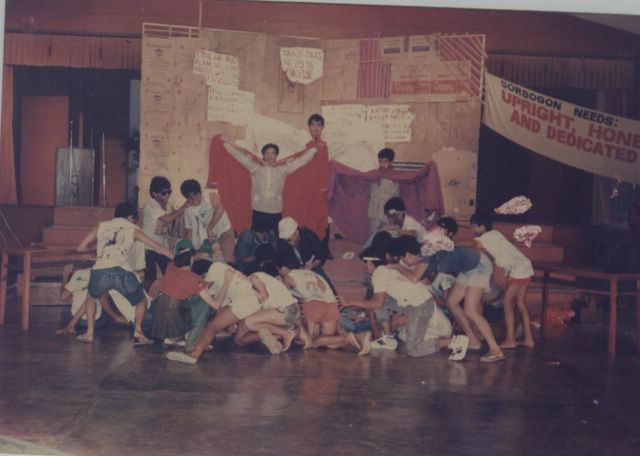
and here's a pic of our "mang serapio." :)
Wednesday, January 11, 2006
long-lost classmates found
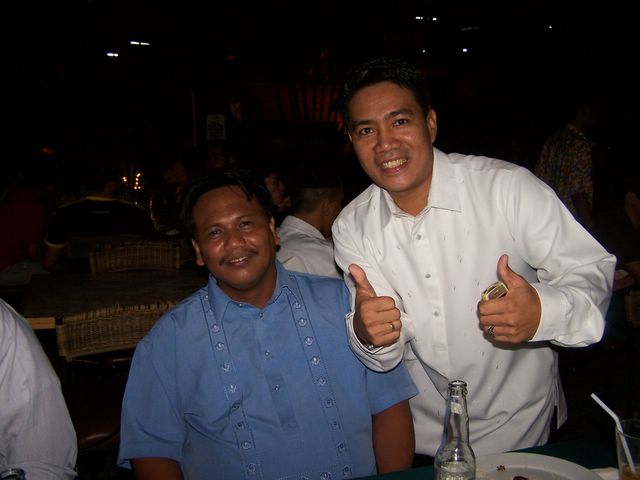
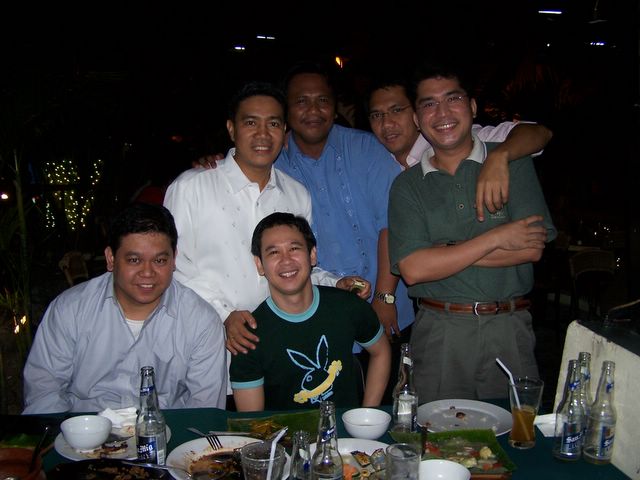
since fr. dandy is in town (until jan. 18), dapat lang me reunion with everyone available. so the manila-based group got together (linuz, erwin, gibbs, tato) -- and managed to find rey nicolas and james cacliong as well! dinner, kwentuhan at inuman (konti lang, mature na, mwehehe) sa gerry's grill sa glorietta makati, tapos more iristoryahan and coffee sa starbucks 6750. ah, brotherhood! salamat sa treat, fr. dandy and rey! :)

rey nicolas and james cacliong, batchmates we haven't seen in a long, long time! rey is in the country for now to work on his wife's US visa while also working as a consultant with a local bank. he had spent 11 years in new jersey before coming home late last year. cacky boy has been with Pag-Ibig Fund for many years, where he also met his wife. they have one kid, an eight-year-old girl.
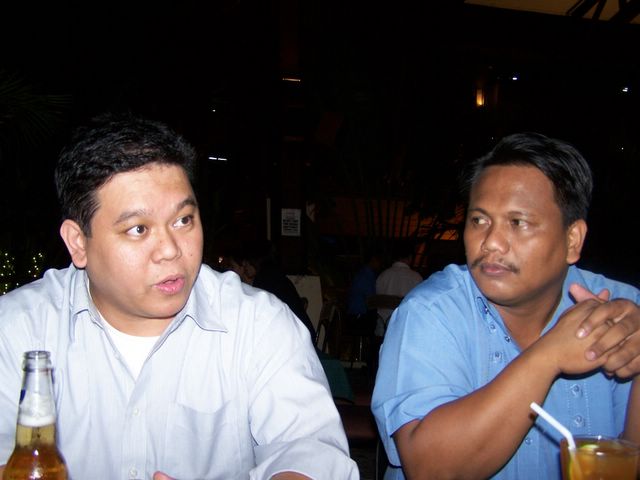
rey nicolas and james cacliong, batchmates we haven't seen in a long, long time! rey is in the country for now to work on his wife's US visa while also working as a consultant with a local bank. he had spent 11 years in new jersey before coming home late last year. cacky boy has been with Pag-Ibig Fund for many years, where he also met his wife. they have one kid, an eight-year-old girl.

padi dandy in town
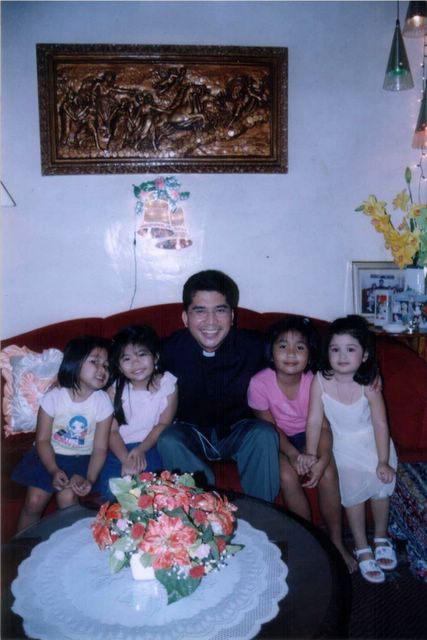
after many years of being abroad, fr. dandy was back in the country last december, to spend christmas with his family in payawin, gubat, sorsogon. as usual, pigbisita siya kan batchmates niya, wives and kids in tow. fr. dandy is as good-looking as usual, bagan dai naggugurang! a member of the Vincentian order, he is now the parish priest of an aboriginal community in Taidong in the eastern part of Taiwan. he speaks mandarin and even delivers his homilies in the language. (sadto naglalapigot siya sa latin and spanish, hehe.) he is also the treasurer of the Chinese Province of his order, and has travelled all over the world as part of his work (except africa, as he says). matibayun si bulate!

cute! fr. dandy with some angels -- batch '87 daughters by totep, ian and lloyd
cute! fr. dandy with some angels -- batch '87 daughters by totep, ian and lloyd


Monday, December 26, 2005
dec. 25 get-together
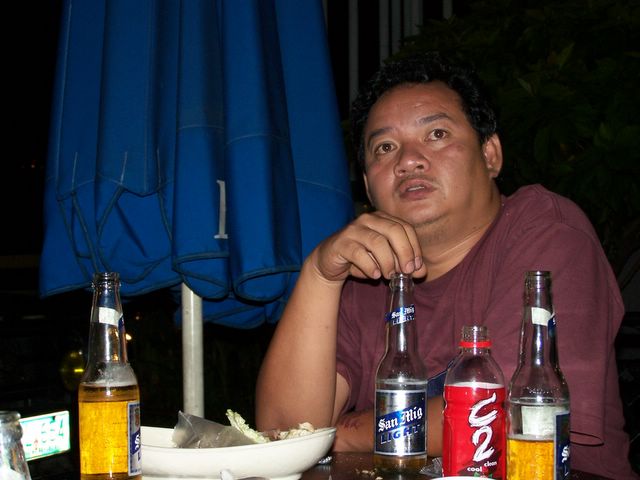
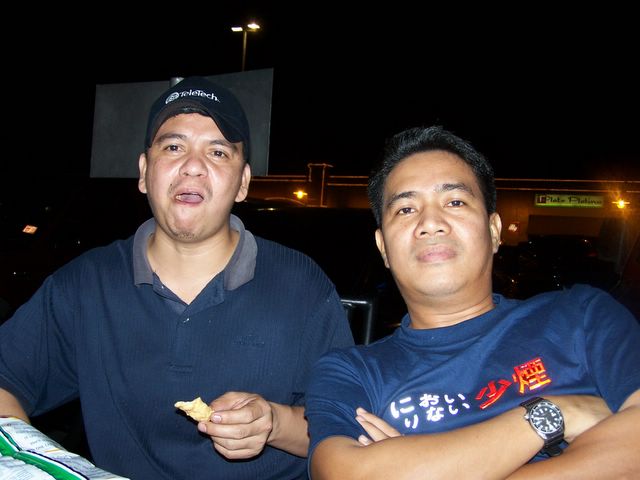
tato, linuz (with son lance), jong, sammy, gibbs and eric gojar of batch '86 got together on the evening of dec. 25 at blue wave for a few bottles of san mig light and iristoryahan, siempre mainly about olps! yes, the brotherhood lives in 2006 and well beyond. maogmang pasko, batchmates and mga sano!

jong, linuz and son lance

jong, linuz and son lance
Monday, December 19, 2005
welcome back and bon voyage, fr. roy eco!
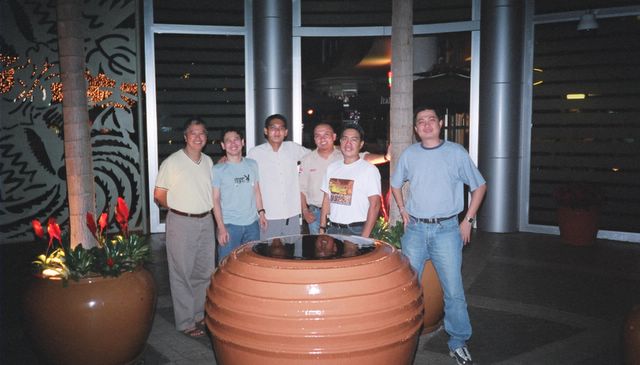
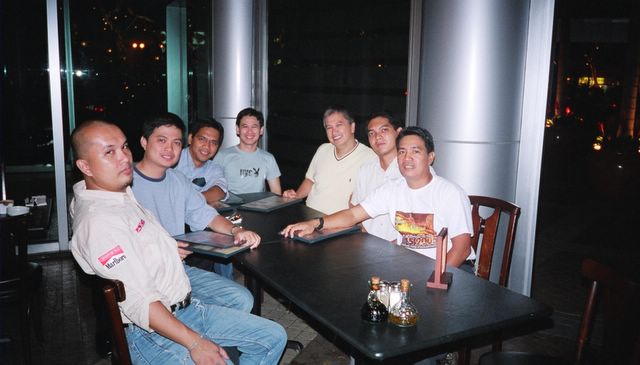
fr. roy eco, now based in florida USA, recently came home for a vacation and met with his favorite former students, batch 87 siempre! :) after spending two weeks in sorsogon and before flying back to the US, he took time to meet and have dinner with manila-based batchmates -- in this case, gibbs, erwin, linuz, totep, jong and tato. we met at starbucks gateway, then proceeded to italianni's for a super-yummy dinner. tapos konting beer and lots of laughs sa klownz! all in all, a wonderful evening with a former mentor who, perhaps more than any other, was closest to us -- because siya lang nagtiyaga sa aton, haha, teaching us Pilipino and directing us in 'ang paglilitis ni mang serapio,' our greatest bonding experience. diri amo, mga bro? :) to fr. roy, maraming salamat and we'll always be here!

at starbucks gateway, waiting for linuz and erwin to arrive. fr. roy himself took this picture.

at starbucks gateway, waiting for linuz and erwin to arrive. fr. roy himself took this picture.

Subscribe to:
Posts (Atom)